Thursday, June 10, 2010

Looking like a Hipster


Skinny jeans aren't the only fashion staple a Hipster needs to leg it around Tokyo. There's much more to cultivating the look (but thankfully less attention to detail than required for some of the other fashions seen in Harajuku mentioned in the previous post).

Malcolm Barnard discusses style as an essential marker of our identity in his text Fashion as Communication: "People appear to need to be social and individual at the same time...fashion affirms both membership of various social and cultural groups and individual, personal identity."

For the hipster there is no greater hurdle. To look hip without being too contrived (unless your outfit is "a commentary on being contrived" as I heard one teacher describe Lady Gaga), to follow without being a follower. Such a complex, existentialist notion, no?(Existentialism is very hip, take a break from reading this and grab a dog-eared copy of Satre to smoke over in your chosen University quadrangle...)

So here I compile a top-secret how-to guide in Japanese Hipster fashions. Keep it to yourself...

How to Wiki Wired says it's all in your t-shirt.
"For hipsters, how the T fits is absolutely crucial. If you're a guy, go for a fitted T: it should hug your torso and have shorter sleeves than your average T. If you're a woman, the opposite is true: your T should look like it came from your boyfriend's closet, so choose a traditional size T a size or two up."
They also reference the need for an ironic accent in "superheroes, manga, classic and indie bands, and nostalgic characters from your childhood" emblazoned on your tee to " a button-up plaid shirt" or "set of fake glasses if you really want to finish off the look".

This still lends a little too much simplicity to a hipster's look. What about hats? Accessories? Shoes? Bottoms other than skinny jeans?

Where do good hipsters find their inspiration these days???
Well there's the streets as aforementioned...but what about websites and stores?

Great websites to take a sneaky peak at what's being worn right now (though a good hipster is far too original for imitation of course) include:

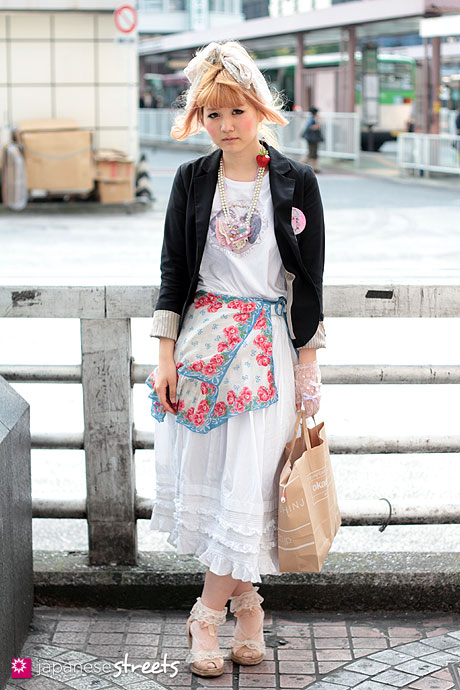
Japanese streets: Beautifully photographed it promises real people, real clothes, real cool! It delivers with a trends, colours and shops section.

Tokyo Dandy: When interviewing Sebastian P, creator of Osharez.com an homage to the cool people of Japan he said that "If you love hipster Fashion you must check out Tokyo Dandy".
I did and now I concur.


Tokyo Fashion: Quite aptly it recognizes that "In Tokyo, there are so many different fashion styles, cultures, and subcultures that it’s hard for even the most devoted fashion freak to keep up."
They counter with photos of Japanese street fashion. Lots of them. As well as Brand guides and a Fashion Map so you can find them.

They claim that "There are literally hundreds, if not thousands, of magazines devoted to Tokyo street and fashion photography. But magazines are published once a week or once a month. In a fast moving fashion mecca like Tokyo, trends may be gone by the time you read about them."

But just for the hell of it....

Vice and Nylon Magazine Japan: Like their American predecessors these magazines seek to be the leading voice in counter-culture wherever they roam. Open a page of Vice and you can almost smell the irony of their helpful Do's and Don'ts section that will guide you away from hipster wannabe to the ultimate in cool (a hipster who refuses to acknowledged as "hip" as they are so post-labels). Open a page of Nylon and you can hear the coos (in as nonchalant a tone one can manage when cooing like a hipster should)of your friends as they exclaim "I like the way you have paired the sailor's hat with those vintage peach culottes and jelly sandals, you look so cute and ironic at the same time! I feel positively passe just looking at you!"

Failing this. A good trawl through a thrift vintage store (op-shop) should sort you out. Just go with a tried and tested hipster formula. Fitted bottoms, draped top, tailored jacket or vest, quirkiness in the accents (hats, bag, shoes).

If you really don't like the idea of buying new threads(although you should, remember eco-chic is incredibly hip)these designers are firm favorites for the non-conforming conformist in us all.

DressedUndressed: Why not be resplendent in slashed bike-shorts, nylon over the elbow gloves or batwing capes in a pallet of all black when you cruise down to Shibuya Station on your fixie? This brand is doing big things and was the talk of Tokyo Fashion Week. So much so they even got a feature in Australian Grazia Magazine's Japan HotList article (April, 2010).

Graniph: If tees are the hipster staple then Graniph should be the Tokyo Hipster's Target. This brand was applauded by Nylon magazine's Japanese and American publications, and rightly so. Graphic tees don't come much more hipster-credible than these with designs from Vintage sports lettering to Scandinavian Graphics.

Ambush: What better to adorn yourself with than jewellery that takes an "ironic look at blingin' gangster jewellery and reinvents it". Fans include Beyonce and Kanye West, but don't let their mainstream cred ruin things...I'm sorry to interrupt and Imma let me finish but designers Verbal and Yoon make some of the best jewellery of all time!!!

Wednesday, June 9, 2010

Hang Out Like a Hipster


Walk the walk before you talk the talk.
Before you madly go scouring the country looking for hipsters (and really that's just a silly way to mess up your carefully deconstructed bangs)...
Here is a list of places where the hipsters of Japan abound and a brief explanation of each in terms of the types of hipsters that hang out there, why and for what reason.

While there are many interesting places to see in Japan both urban and rural if you are seeking hipsters Shibuya, Tokyo is where it's at!

For Japanese hipsters Tokyo is New York and Shibuya is their answer to the East Village.

Although colloquially it refers only to the direct area around Shibuya Station, the area is a ward (read: district)of Tokyo that includes the famous Centre Gai, Harajuku and Yoyogi Park.

Dr Brian Morris, Lecturer in Communications at RMIT University lived in Tokyo for 7 Months and was increasingly drawn to the Shibuya area for: "its crowds of trendsetting, keitai (mobile telephone)-toting youth, as well as fashion-conscious youth subcultures, who have in various highly visible ways claimed the area as their home over the past 30 or more years..." (See the link for his extended article on interpreting the digital environment of the Shibuya shopping districts large television screens above)

Shibuya Station: The Hachiko Exit crossing outside this famous station claims to be the busiest in the world. While hipsters prefer a slower walking pace, and the intersection would be difficult to navigate on your fixie take note; scenes from Lost In Translation by indie film darling Sofia Coppola were filmed on the crossing. Inside the station there is also ample opportunity for some people watching and practicing your disaffected "I'm just getting from A to B in an effortlessly hip fashion" face.


(Scarlett Johansson, practicing said face)

Centre Gai: This narrow street is the place to see or be seen right in the heart of Shibuya's main shopping strip (which just happens to be the main hub of Tokyo's fashion district). It houses stacks of alternative clothing and music stores perfect for the hipsters main needs. It also has a bit of an edge as the entry on user-generated-content travel site mapme describes an undercurrent of drugs, brothel recruiters and "less-than-savoury-characters" who trawl the Gai for trade...A perfectly dark undertone to attract the subversive types to what is essentially a commercial shopping strip.


Centre Gai (Japan's Answer to Centre Place and De Graves?)

Harajuku: This is the most famous of all Japanese trend setting hot spots. Though its infamy and attractiveness to tourists has lead to a slightly lowered status in the hipster crowd ("Harajuku has become more of a mosh pit than it used to be", CNN 2010) it is still the birthplace of most Japanese trends and good spot to show off your latest (vintage, experimental, indie, or ironic) threads.
Other styles of dress also on show here are:

Xexiun Liu discusses the overt displays of self expression through fashion in the Shibuya Ward in relation to the Ganguro style of dressing, but his insights can reveal the purpose or inspiration behind subcultures in Japan generally. Liu outlines 3 contributing factors in the formation of subculture
1. It "reflects the global influence of...culture and affects Japanese youth ideology".
2. "It is an explicit expression of self- identity of those who attempt to depart from traditional Japanese cultural values and social standards."
3. The "subculture is in conflict with mainstream Japanese culture, and although this subculture may not spread to the whole Japanese younger generation, it has socio-cultural and ideological significance in Japanese society".

(Vintage and Kogal style in Harajuku)

Yoyogi Park: The largest Park in Tokyo is a rad place to lounge around drinking Kirin's and soaking up a bit of sun, reading a zine (that you published yourself of course), attending the EcoLife fair or getting a wild groove on (perhaps not if the claim "The dance floor at a hipster party looks like it should be surrounded by quotation marks" is to be believed)to one of the many music festivals held here such as the OneLove Jamaica Festival.

(OneLove Jamaica at Yoyogi Park)

The best part of all these destinations is they're easily in reach of public transport on the JR Yamanote Train Line.
Any good hipster knows that being green is great (and we're not just talking about the rollies you make for OneLove).

Hipster Schmipster


What is a hipster anyway...?
Well may you ask. And it's a valid question if the premise of the blog is to give its readers the ability to transform into the new hipcats of Japan (like Pokemon with less oddly named cartoon critters and more instructional prose...)
First let me tell you what others think, from the font of knowledge that is Urban Dictionary.
"Hipsters are a subculture of men and women typically in their 20's and 30's that value independent thinking, counter-culture, progressive politics, an appreciation of art and indie-rock, creativity, intelligence, and witty banter.
Although "hipsterism" is really a state of mind,it is also often intertwined with distinct fashion sensibilities. Hipsters reject the culturally-ignorant attitudes of mainstream consumers, and are often be seen wearing vintage and thrift store inspired fashions, tight-fitting jeans, old-school sneakers, and sometimes thick rimmed glasses. Both hipster men and women sport similar androgynous hair styles that include combinations of messy shag cuts and asymmetric side-swept bangs."

Interesting (also mildly hilarious that every poster on Urban Dictionary tries to write in a legitimately "serious" dictionary style).
Surely though there is more to "hipsterdom" than skinny jeans, geek glasses and vintage?
A key aspect of hipster fashion, humor and attitude is irony. As it is a sub-culture that springs from post-modernism even the name "hipster" is ironic; as it is post-cool, post-hip, post-trend, post-fashion. As Encyclopedia Dramatica will tell you (another worthy source):
"The "Hipster"'s lifestyle is shrouded in a mystical rhetorical substance known as "irony". It is said that "hipness" manifests itself in areas where there is the most irony. Irony is a difficult concept to understand, so perceiving it takes hipness in itself. Irony can also be perceived or created out of such things that are "unhip". Where ever the irony is, once perceived by the "hipster", the "hipster" must begin to decode the irony for hidden messages and must take the messages of the great "hip" to heart. If you see a "hipster" lethargic on the couch watching "Gillian's Island", this is what he is trying to do."

A hipster in Melbourne (a shy beast found mainly in areas such as Fitzroy, St Kilda and Brunswick possibly drinking a soy based beverage) might wear a "Beaches" tshirt as part of an ironic statement against naff 1980's melodrama (or a secret harboring of love for the Midler). This would be considered funny in its brazen irony by their hipster friends and so the uncool act of plastering Bette Midler across your chest at VegieBar becomes "hip".

It is essential we understand the concept of irony and the "hip" in Australia or New York if we are going to grasp the ideas (and differences) of "hipness" in Japan.

Irony as a concept is not an organically Japanese notion. Irony, sarcasm and cynicism are all represented by the exact same word in Japanese (hiniku 皮肉). This has lead to a perception that Japan has an inability to understand irony in humor when a slapstick style is more traditionally favored. (See forums on JapanReference or Denshi Jisho)

This is not uncommon in other Asian nations either, for example Slate Magazine published an interesting and quite apt article by David Goodman on the subject of irony being lost on Chinese audiences in relation to the "fixie" (fixed-gear or no gear) bike trend that was popularized by the Western hipster scene.

In it Goodman attests to the difficulties of irony translating in China through a quote by Juanjuan Wu, a professor at the University of Minnesota and author of Chinese Fashion From Mao to Now:
"Hipster fashion only really works by communicating your irony—in other words, someone needs to 'get it.' Hipster irony in dress would most likely be misinterpreted in Chinese society as simple poverty or weirdness."

So how can hipster culture that is so intrinsically linked with notions of irony survive in Japan? Because irony does indeed exist in Japan. But why Japan if not China?
Perhaps we can refer back to Douglas McGray's article Japan's Gross National Cool from my last entry in order for a comparison and explanation to present itself.

Japan and China are historically very different and yet in broad factors strikingly similar. Both are steeped in a tradition of complex hierarchy and Confucianism (Japan's experience was slightly different but the essentials are there), both had experiences as strong national powers, both saw this power collapse or erode through war and tension in a similar time(Japan in the World Wars, China after the Civil War), both were forced to rebuild their society and culture after these events.

However the main difference between Japan and China is that while China became insular and closed off from globalizing influence under Communism, Japan chose to rebuild with aforementioned "fusing elements of other national cultures into one coherent whole".

McGray attests this process of globalized cultural trait formation has continued. So this may explain why youth in China can't understand the irony of a fixie while Japanese hipsters laugh it up in their ironic glasses, bow tie and Diff'rent Strokes Tees.

Tuesday, June 8, 2010

Why Japan? Why Hipsters? Why Now?

Some will tell you it
started with a handbag...
When Lady Gaga: singer, celebrity and unnatural-fiber-enthusiast touched down in Japan on her Monster's Ball Tour this April she brought with her a message scrawled on her Hermes Birkin Bag.
"I love little monster, tokyo love"

Regardless of the poor translation and use of the Katakana alphabet the transmission was clear: Japan is hip.

However the Western world's love affair with Japanese Pop Culture isn't a recent one, just a resurfacing of an ongoing obsession with the inexplicable cool-factor Japanese Pop Culture holds.

Do you recall Gwen Stefani's strange obsession with the fashions of Harajuku and her entourage of small Japanese girls she dubbed her Harajuku girls in 2004?

Then how about the abundance of Memoirs of A Geisha novels being leafed through by the mid-30's soy-latte-devotees of every inner-city Suburb in the wake of its glowing review in the New York Times in 1997?

Surely you must at least recall the scene in 1985's homage to teen-angst The Breakfast Club where the ever pink-cheeked Molly Ringwald decrees "It's Sushi! Rice, raw fish and seaweed...It's very popular!"

Nothing?

I must say I don't believe you...

Renderings of Japanese pop-culture are everywhere. Take a look around. Is that green tea in your mug?!
Don't laugh at me! I see your grey Kenji Urban jumper and your Nudie jeans(that use salvaged vintage Japanese denim of course)and I raise you a Hello Kitty umbrella, a hilariously kitsch Gamera dvd and an Astro Boy poster. And that's just what sits immediately to my right in this study.

But what's the ubiquity all about? What is it about Japanese pop-culture that has us dressing like anime characters, slathering our lunches in wasabe and loading our new Sony gadgets up with Japanese hip-hop and video games in the hopes of seeming edgy and globalized?

It's not just an idle question. Academics want answers just as much as you or I (more I than you, but I hope this changes as this blog progresses...)

In 2002 Douglas McGray wrote an article titled "Japan's Gross National Cool" for Foreign Policy Magazine that first discussed the notion that Japanese Pop Culture had something other globalized customs did not: it worked outside the Centre-Periphery concept of Western money/ideals/modernity driving the Eastern market.
"Japanese Culture has transcended US demand or approval" (McGray, 2002). It was post-modern before post-modernism was considered in the West as it had to recover and adapt from its great fall from being an international superpower post-WW1 and WW2. Modernity simply could not be met in the same way as the West was doing it with an almost non-existent military, recession and falling Gross Domestic Product rates. So Japan cleverly began rebuilding its culture by blending tradition and "fusing elements of other national cultures into one coherent whole"(McGray, 2002).

McGray's work got the world talking and in 2007 (The Massachusetts Institute of Technology) MIT and Harvard launched the Cool Japan Project to try and further understand what makes Japanese Pop Culture so adoptable and the potential of it to be distorted by its consuming audiences.

Ian Condry, founder of the Project had this to say about his own personal interest in Japanese Culture in an interview with Henry Jenkins:
"The idea of "cool Japan" really took off with the publication of journalist Douglas McGray's 2002 article ... He argued that Japan had become a "cultural superpower," despite a decade-long recession that began in the early nineties. It has also changed the attitudes of American's interested in Japan... "

"The real power of popular culture is making stereotypes seems less compelling, and to force us to ask more complex questions about cultural differences."

Could a key question then be asked: If we acknowledge Japanese Pop Culture is setting trends in the West...What then is inspiring these trends in Japan?

That is the purpose of this blog. Rather than recycling someone else's rhetoric that ultimately concludes Japan to be a major player in the globalization or homogenization (depending on which side of the fence you sit) of Pop Culture trends; let us examine what is "hip" in Japan NOW and why so that we may further understand where the "gross national cool" of Japan is borne from and perhaps predict where it may lead.

So, here my friends, feast on what is to come:
A guide on "How to be a hipster in Japan".
Live it. Love it. Be it. So that one day you may understand it.
ではまた後で。
Dewa Mata Atode!
See you later!